e-Invoicing in Belgium
Mandatory E-invoicing in Belgium
Eliminate compliance risks in Belgium and gain insights into the digital reporting rules of 70+ other regions.


Who is obliged to use e-invoicing in Belgium?
Belgium has already introduced mandatory e-invoicing for B2G transactions. All Belgian public bodies are already obliged to be able to receive and process electronic invoices in the context of public procurement, which makes it mandatory for all federal government suppliers to issue electronic invoices (transposition of Directive 2014/55/EU). This obligation applies to contracts above EUR 3,000. Invoices with amounts below EUR 3,000 are exempt from the mandate, though public bodies must remain capable of receiving them.

Is e-invoicing mandatory for B2B?
The legal framework imposed mandatory B2B e-invoicing from January 1, 2026, requiring structured formats (primarily Peppol or other standards compliant with EN 16931) and planned phases for real-time reporting. Both B2C and B2B reporting requirements are also planned for future implementation phases.
E-invoicing implementation timeline
- October 2022 – Mandatory B2G e-invoicing for public contracts and concessions with a minimum value of EUR 215,000.
- April 2023 – Mandatory B2G e-invoicing for public contracts equal to or greater than EUR 30,000.
- October 2023 – Mandatory B2G e-invoicing for public contracts and concessions with a value of EUR 30,000 or below.
- March 2024 – Mandatory B2G e-invoicing for all taxpayers.
- January 2026 – Entry into force of mandatory B2B e-invoicing based on Peppol. The mandate applies to all VAT-taxable entities with a fixed establishment in Belgium conducting B2B transactions, except:
1. Taxable persons exclusively performing VAT-exempt transactions under Article 44 of the Belgian VAT Code (e.g. specific medical services, cultural activities);
2. Taxable persons in a state of bankruptcy;
3. Taxable persons applying the flat-rate scheme under Article 56 of the Belgian VAT Code;
4. Transactions involving the supply of goods outside Belgium, where no Belgian Tax ID is required.
- January 2028 – The Belgian government introduces a mandatory near real-time e-reporting system for tax purposes.

E-invoicing process description
Since March 1, 2024, federal contracting authorities have also been required to implement electronic invoicing for transactions under EUR 3,000. Since January 1, 2026, structured electronic invoicing has been mandatory for almost all B2B transactions conducted by Belgian enterprises subject to VAT. However, this requirement does not apply to goods or services supplied directly to consumers for private use (B2C transactions).
This structured invoicing requirement will generally apply to transactions between two Belgian VAT-liable enterprises, with a few exceptions:
Structured electronic invoices are not required for:
- persons subject to VAT who are bankrupt,
- businesses conducting exclusively VAT-exempt transactions under Article 44 of the VAT Code,
- VAT-liable persons without a permanent establishment in Belgium,
- VAT-liable persons are taxed on a flat-rate basis (per Article 56 of the VAT Code, which is set to expire by January 1, 2028).
Additionally, there is no obligation to be able to receive structured electronic invoices for:
- enterprises conducting exclusively VAT-exempt transactions as specified in Article 44 of the VAT Code.
In general, if a transaction is VAT-exempt under Article 44 of the VAT Code, there is no requirement to send or receive structured electronic invoices.

Format and platform
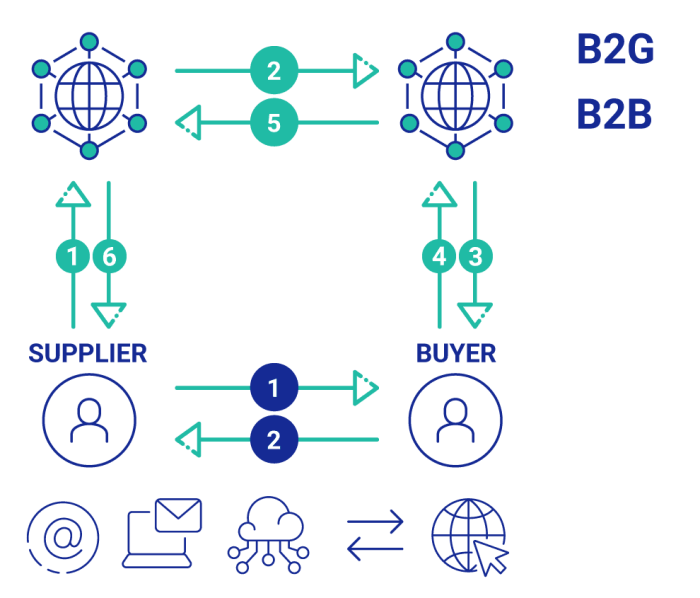
There is no government platform. B2B e-invoices proceed via the Peppol network, in Peppol Bis format (unless by mutual agreement and in compliance with EN16931).
- Format: BIS 3.0
CEN-compliant formats can only be used for the transmission outside of Peppol.

How can Comarch help?
Comarch is a certified Peppol access point. Under the four-corner Peppol model, the buyer and supplier exchange invoices via an access point, which is a Peppol-certified service provider that ensures data security and compliance with Peppol standards (for example, UBL format or AS4 communication protocol).
Legal regulation changes in Belgium



Achieve Global e-Invoicing Compliance with Comarch
-
Unilever
The implementation of electronic data interchange at Unilever -
Leroy Merlin
Comarch Document Management and Exchange Platform for Leroy Merlin -
Agfa
Implementation of Comarch e-Invoicing at Agfa-Gevaert Group -
BIC
Comarch EDI Complex Services for BIC -
Lidl
Comarch e-Invoicing at Lidl -
METRO Digital
Comarch EDI at METRO Digital -
Danone
Benefits of implementing Comarch Electronic Data Interchange -
Kraft Heinz
Comarch Master Data Management (MDM) Project -
ObjetRama
Comarch EDI at ObjetRama -
Volotea
Digitize Billing Processes With Comarch E-Invoicing -
Technicolor
Implementation of Comarch EDI at Technicolor -
Carrefour Poland
Comarch EDI at Carrefour Poland -
Red Bull
Red Bull actively develops business processes by using modern Comarch solutions -
Colgate-Palmolive
Online Distribution and Mobile Sales Force for Colgate-Palmolive -
Balconi
Implementation of Comarch EDI at Balconi -
La Redoute
Implementation of Comarch EDI at La Redoute -
Italcementi
Italcementi and Comarch: Improving business efficiency by digitizing invoicing processes -
Bolsius
Implementation of Comarch EDI solution for Bolsius -
Belmond Group
Belmond Group Chooses Comarch to Update its E-invoicing and E-archiving Systems -
Angelini Holding
Angelini Holding S.p.A Chooses Comarch EDI Platform for its Foreign Branches -
Sammontana
Sammontana Chooses Comarch Master Data Management -
BayWa
BayWa Implements Comarch EDI to Meet the Upcoming B2G E-invoicing Obligation -
Ursus Breweries
Comarch E-invoicing Helps Ursus Breweries Meet New Legal Requirements in Romania -
Heidelberg Materials
Global Digitization with Comarch EDI at Heidelberg Materials -
Monini
Monini chooses Comarch’s EDI platform -
Mutti
chooses Comarch EDI for multi-country data processes -
De Cecco
Comarch EDI at De Cecco -
La Doria
Processes of Electronic Data Interchange in E-commerce